Search This Blog

Monday, May 6, 2019

The Budget Collector

Perhaps you, like me, have fallen in love with the beautiful blue-and-white loveliness that is Spode dishes. (Or perhaps their red, brown, or green dishes are the object of your affection.) And perhaps, like me, you can't afford to go to Spode.com and order twelve place settings and all the serving dishes you could ever want.

Well, if you're like me, this post is just for you!

As I've mentioned, I'm a Spode collector, but I'm also working with a rather small dish budget. It's actually rather amazing the different places I've ended up finding Spode, so I thought I'd share some of my favorite venues for the ever-so-exciting Spode-collecting treasure hunts.

  • Antique Shops: (especially those lovely cluttered ones that let lots of people put their items on consignment... sometimes they have cheaper prices than snooty, well-organized ones.) These can still be a bit pricey, but if you're looking for something specific like the spice jars I recently posted about, it can work out great! 
  • Thrift Stores: These can have great bargains, especially if your Spode find is the 50% off tag! However, thrift Spode can be few and far between. I rarely actually find Spode in the thrift stores here in Oregon. That having  been said, I did find these lovely candlesticks in the Ionian pattern just last Thursday!
    (So it's possible... just be patient!) --This is probably the cheapest way to buy Spode.
  • New in Stores: (On clearance if it lasts that long!) The first Spode dishes I ever bought were new from Tuesday Morning. I've also found Spode at the Marshall's family of stores (Home Goods and T J Maxx are part of that "family", but all three tend to stock different pieces of Spode). The prevalent Staffordshire wares in stock this year seem to be mostly Churchill and Johnson Bros. (Good stuff, but not quite as lovely as Spode in my opinion.) As far as price goes, brand new dishes tend to be more expensive, but if you can wait long enough (and they don't sell out), the clearance prices are usually much better.
  • eBay: This is the way I have found most of my Spode pieces. One of my prized possessions is a soup tureen in the Tower pattern. I ended up winning it with a dramatic last-second bid, and paid only $51 plus shipping for a tureen which I knew was an actual antique (more on that later!). You can also sometimes get things for $0.99 plus shipping if you are the only bidder. The one drawback to eBay is that you have to pay shipping, which usually means that your actual output for an item is roughly what you would have paid at an antique shop. (unless you find a steal or the seller offers free shipping). 
  • Clearance: One other way I have purchased Spode is from Spode.com. They sometimes have clearance items (I think they might now call their clearance section the "Great Deals" section or something like that), which is where I found the mug and tin which was featured in my recent post about the Lucano pattern.
These are all the best places I've found so far. I've heard that garage sales can be great sources, too, and I'm looking forward to using some of my time off this summer to go garage sale-ing in search of Spode.

--A quick question to any readers out there: What's your favorite way to find bargain Spode? Comment and share your answer! :)

Friday, May 3, 2019

How to Safely Remove Price Stickers and Their Residue: A Tale of Six Spice Jars


                It was Friday, the final day of my much longed-for Spring Break, which also happened to be the day after my birthday, and I awoke with grand visions of washing my new Spode dinner plate, doing some research, and maybe even cooking something. When I went to the kitchen to make myself breakfast, I was greeted with the news that our sink was leaking. (There went the dish washing…), and when I tried to begin the research I had been planning on finishing, the internet was out. We tried and tried to fix it, but to no avail.

Now, at this point it must be acknowledged that I believe in the purposefulness of God –He never wastes anything, and He never allows anything that He will not use in some way for the furtherance of both His glory and my good. That having been said, I must admit that I struggled, knowing full well that this redirection of my day was not to be ignored or whined over, but wondering what it was that I was supposed to do instead.

For whatever reason, the only thing I could think of doing with my day which did not involve either the internet or the kitchen sink was to go to a neighborhood of antique stores nearby. I asked my mom to come along, and as we drove, I commented, rather Gideon-like, that if we found some amazing find, I would know that I was supposed to go antiquing that day. I was half joking, but was surprised when we found very little at the first shop, which had a stack of Spode, but not exactly what I was looking for, and for more than I would have paid. I did find one thing, but it didn’t strike me as a great find.

We went to the next shop, and while my mom was lingering over some books in the first room, I wandered through the hall to the next, and was greeted with an amazing sight: there, in a glass case, were six Spode spice jars of different patterns. I had been looking at spice jars only that morning, and the individual jars I particularly wanted usually went for around $40 each. There in front of me were six, including two of the patterns I had been looking at, but for the unbelievable price of $8 each!!

I tried to walk very calmly back through the hallway to where my mom was, and then back to the room to show her my amazing find, but I’m sure I didn’t do a great job of concealing my excitement. When I went to pay for the jars, I found out that they had been brought in just that morning (while we were at home trying in vain to fix the internet). The timing was just right, and I was so thankful that God had redirected my day!

Now, I know this was a lengthy introduction, and you might be wondering where the practical part begins, and here it is: The spice jars each had an inordinately large price label on them, right over the best bits of the pattern. When I got them home, I was greatly disappointed (and annoyed) that they seemed to be paper labels stuck on with paste or something else that held firmer than ordinary price tag adhesive. I tried scraping at them with my fingernail (heretofore my most successful method of removing such stickers), I tried soaking the label in hot water, but nothing seemed to be working. I didn’t want to damage the jars, so I was in quite a quandary about what to do next, until I remembered that I had pinned something on Pinterest about removing adhesive from things. 


 As it turned out, plain old vinegar, that household panacea, takes both adhesive and label off cleanly, and with ease! 


  I will say, the more vinegar you have on your rag, the faster and easier the sticker comes off. If the vinegar isn’t squeezing out of the rag while you scrub, it will take a great deal more elbow grease to remove the sticker and adhesive. 


Since that day, I have used vinegar to remove residue, scotch tape marks, and even whole price tags on items from Spode, Tuesday Morning, Home Goods, and Goodwill, as well as several other stores. –Kudos to Value Village, by the by, for using price tags that come easily off their items and only occasionally leave a very minimal amount of residue!

Friday, April 12, 2019

The Lucano Pattern


       One of my most treasured finds from that very first trip down the Spode aisle at Tuesday Morning is some lovely plates of the Lucano pattern. Honestly, as I dug through the stacks of Blue Room Collection plates, I saw one with this pattern and immediately put several in my tiny stack of plates. I was so excited to show my family the plates I had found that had “a castle” on them! Since then I have also found a small open vegetable dish and a mug (which came in a matching tin on clearance from Spode.com!)


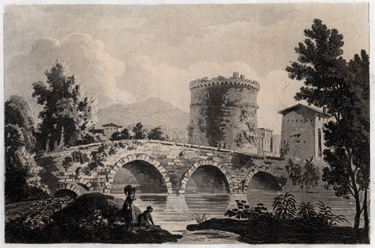
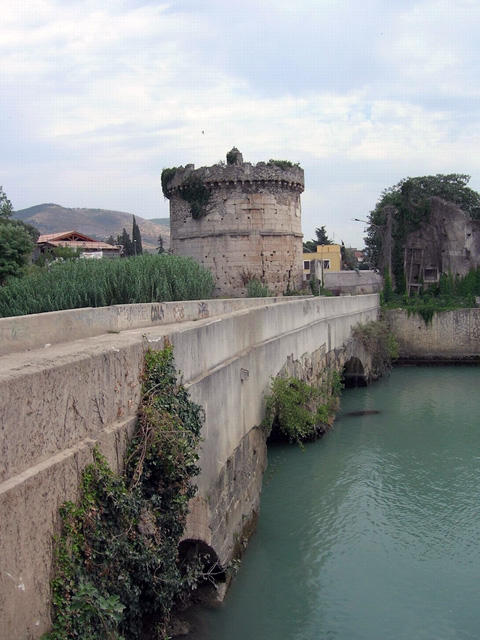
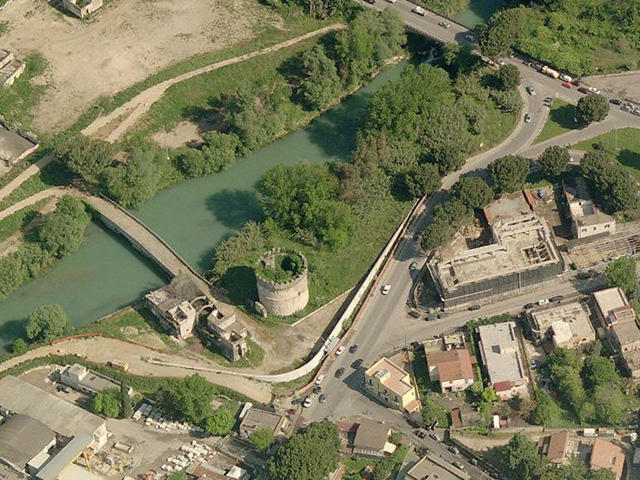
      The pattern itself is based on an aquatint engraving which was originally published in 1798, which features in the foreground the Bridge of Lucano, (Ponte Lucano) a first-century Roman bridge which is a historic site still recognizable today!

Original Aquatint by James Merigo from artisopusgallery.com 

          In his book, Antique Blue and White Spode, Sydney B. Williams gives a good summary of the history and significance of this beautiful place:

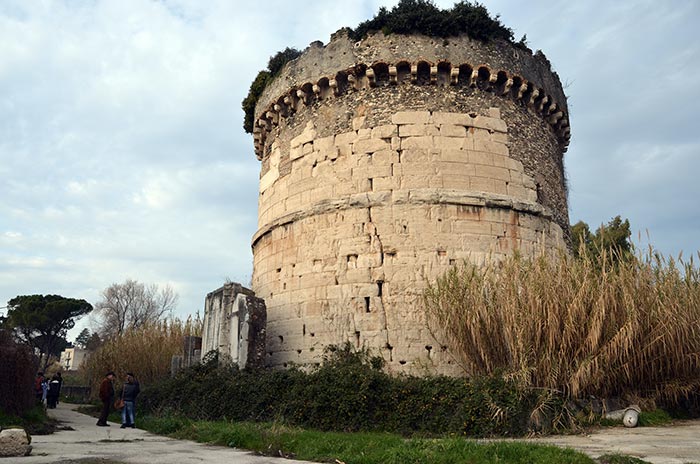
          “This bridge, sixteen miles distant from Rome, derives its name from a victory obtained by the Romans over the Lucanians. It was rebuilt by Tiberias Plautius, who possessed a villa adjoining to it. His magnificent family tomb stood in the same neighborhood. This ancient tomb, round in form, and much resembling that of Caecilia Metella, was repaired by the Goths and converted by them into a fortress.

           The bridge has become well known from engravings and also from the beautiful picture by G. Poussin in the Doria Palace. [see here.] It has been crossed by many warriors of the past, heavily-armed against all foes except deadly malaria, which has played a commanding role in the politics of the Eternal City of Rome." (p.116)

For more on the history of Lucano, you can visit its World Monument Foundation page by clicking here.


Monday, April 8, 2019

A Spode by Any Other Name


Spode dishes have undergone several phases of ownership over the years, and consequently, the markings on Spode pieces can be a bit confusing to the beginning collector. Perhaps you can relate to my experience the moment I picked up a dish with what I recognized as a classic Spode pattern, only to confusedly think, “Copeland?... Who’s Copeland?... This is a Spode dish!” If so, this post is for you!

Here it is in a nutshell: 

1776-1833 The earliest pieces may not have any markings at all, or could even be marked just with an x inside a circle. Early Spode often has just the Spode name impressed into the pottery, and could also have the Spode name painted on (with varying styles or fonts). 

1833-1847 Next is the “Garrett & Copeland” era, when the company was bought by joint owners (hence the name). Copeland bought the company outright in 1846, ushering in the next phase of markings.

1847-1966 The markings from this period sometimes feature just the Copeland name, but markings from throughout the whole Garret/Copeland eras often include the Spode name, as on the demitasse cup below, or even the phrase “Late Spode”. 


 1966-Present This era saw the return of the traditional Spode name. Early in this period, markings tend to have just the name printed on in a calligraphy-type font. Newer pieces feature helpful words like “dishwasher safe”, and often a short history of the pattern in the same blue ink as the pattern on the front, specifying the original date of production for that particular pattern. 

For a more specific, in-depth history of Spode and its owners, see the Spode Museum Trust site (link here), and for a good visual timeline of Spode History, check out Spode History here on Blogspot.