Search This Blog

Showing posts with label Why Spode?. Show all posts

Tuesday, August 6, 2019

Bringing Out the Beauty of Boring Breakfasts

This week, two of my lovely nieces are visiting, and we decided to have a "fancy" breakfast. However, we had plans for mid-morning, so our breakfast time was somewhat rushed. We were determined to make our hum-drum eggs and cereal a memorable meal, so I rummaged in my "Spode bin" (as one niece calls it) for some pretty dishes.

The results were rather beautiful.


Not only did the food look amazing against the blue Spode, it was yummy (thanks to my younger niece who made us eggs!) and we had fun looking at the different patterns and discussing them.


A card table and an old lace curtain set outside were an easy way of bringing some elegance to our chocolate Chex cereal and scrambled eggs.


Monday, June 3, 2019

New vs. Antique Spode

When I began collecting my Spode dishes, I had little thought of becoming a serious collector of any kind: I just liked the dishes, and decided to buy them. As I began learning more about the dishes, however, I realized that one reason I liked them so much was because they were reproductions of old Spode I had seen and admired from childhood (though unknowingly at the time). Some of my favorite places had blue and white patterned dishes, and even the historic sites my family visited often had antique Spode as part of their exhibits. (Posts on those sites and their collections yet to come!)

And then there was the day I discovered a soup tureen on eBay for a surprisingly small opening bid. I looked at the pictures and saw the mark on the back. I remembered seeing a page in my go-to reference book Antique Blue and White Spode with a table of back markings and their dates, so I looked it up and, to my surprise, found it to be "perhaps the earliest marking"! Needless to say, I placed my bid right then, thrilled at the thought of owning a real antique piece of Spode! To my great disappointment, I was outbid. I watched the item until the end, though, when, quite dramatically and at the very last second, I placed another bid and won it back! I later found out that it dates from 1800-1820, during an era in which such historical events as the Battle of Waterloo and the War of 1812  were taking place.

The excitement of actually owning a piece of antique Spode spurred me to do some research as well as to do some practical thinking about the pros and cons of antique versus new Spode dishes.

The benefit of the antiques is mostly that of being able to hold in your hands a real piece of history, which has been held and used and cared for by the hands of generation after generation of people who lived through events and times we can only study about. It is even more meaningful if you happen to know about the prior owners of your Spode.

I have often wished there were a way to find out something about the people who owned my soup tureen, and have wondered whether the hands that washed it belonged to a servant or housewife, whether it stood on a grand mahogany dining table or on a rough wooden kitchen table. I wonder whether it was ordered by an American who sent a letter that crossed the seas to England, or whether it was brought over with an immigrant family as treasured possession. Did it have pride of place in a hutch or Welsh dresser, or was it just another dish? If you have an active imagination with a historical bent, these are the thoughts antique dishes inspire.

However, if your love of transferware comes with more of a practical mindset, then new Spode might be for you. These dishes are dishwasher and microwave safe and, like their older counterparts, are quite sturdy. Thus, you can have the look and quality of antique dishes with all the modern convenience of new dishes.

I suppose that's one reason why I love these Spode dishes so much: they are timeless classics, but still produced. I chose new Spode plates for my every day dishes because I knew they were replaceable if broken, and the older pieces I have are special because of their age, but they are of such good quality, I can actually use them just as I would newer dishes.

Monday, May 6, 2019

The Budget Collector

Perhaps you, like me, have fallen in love with the beautiful blue-and-white loveliness that is Spode dishes. (Or perhaps their red, brown, or green dishes are the object of your affection.) And perhaps, like me, you can't afford to go to Spode.com and order twelve place settings and all the serving dishes you could ever want.

Well, if you're like me, this post is just for you!

As I've mentioned, I'm a Spode collector, but I'm also working with a rather small dish budget. It's actually rather amazing the different places I've ended up finding Spode, so I thought I'd share some of my favorite venues for the ever-so-exciting Spode-collecting treasure hunts.

  • Antique Shops: (especially those lovely cluttered ones that let lots of people put their items on consignment... sometimes they have cheaper prices than snooty, well-organized ones.) These can still be a bit pricey, but if you're looking for something specific like the spice jars I recently posted about, it can work out great! 
  • Thrift Stores: These can have great bargains, especially if your Spode find is the 50% off tag! However, thrift Spode can be few and far between. I rarely actually find Spode in the thrift stores here in Oregon. That having  been said, I did find these lovely candlesticks in the Ionian pattern just last Thursday!
    (So it's possible... just be patient!) --This is probably the cheapest way to buy Spode.
  • New in Stores: (On clearance if it lasts that long!) The first Spode dishes I ever bought were new from Tuesday Morning. I've also found Spode at the Marshall's family of stores (Home Goods and T J Maxx are part of that "family", but all three tend to stock different pieces of Spode). The prevalent Staffordshire wares in stock this year seem to be mostly Churchill and Johnson Bros. (Good stuff, but not quite as lovely as Spode in my opinion.) As far as price goes, brand new dishes tend to be more expensive, but if you can wait long enough (and they don't sell out), the clearance prices are usually much better.
  • eBay: This is the way I have found most of my Spode pieces. One of my prized possessions is a soup tureen in the Tower pattern. I ended up winning it with a dramatic last-second bid, and paid only $51 plus shipping for a tureen which I knew was an actual antique (more on that later!). You can also sometimes get things for $0.99 plus shipping if you are the only bidder. The one drawback to eBay is that you have to pay shipping, which usually means that your actual output for an item is roughly what you would have paid at an antique shop. (unless you find a steal or the seller offers free shipping). 
  • Clearance: One other way I have purchased Spode is from Spode.com. They sometimes have clearance items (I think they might now call their clearance section the "Great Deals" section or something like that), which is where I found the mug and tin which was featured in my recent post about the Lucano pattern.
These are all the best places I've found so far. I've heard that garage sales can be great sources, too, and I'm looking forward to using some of my time off this summer to go garage sale-ing in search of Spode.

--A quick question to any readers out there: What's your favorite way to find bargain Spode? Comment and share your answer! :)

Sunday, April 7, 2019

The Wind in the Willowware: or, Treasuring the Classics


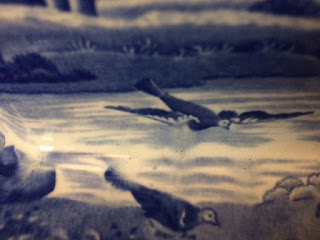
Detail from the foot of a Spode's Tower soup tureen.

Last summer, I took a Children’s Literature class. (Don’t worry… this really is a post about dishes. -Be patient and we’ll get there!) At first, I expected to read lots of familiar things, but I quickly found that my professor required that we read books that we had not ever read before. She wanted us to befriend our local children’s librarian, dig into our textbook book lists and discover all the books we’d heard of but never actually read. In short, she wanted us to be exposed to the greatest volume of quality children’s literature possible. (And in a very short amount of time!)

That was how I ended up reading The Wind in the Willows… in less than 24 hours… during the intensely busy Neighborhood Bible Time week. 

I had heard it quoted, and had even seen a cartoon version of it sometime during my childhood, and recognized it when I saw a beautiful edition at some store or other. I bought it, shelved the beautiful new blue and goldenrod volume on my shelf, and never got around to reading it –until last summer.

Somehow I had missed the fact that Kenneth Grahame’s story about Mole and Ratty and Badger was a widely-recognized children’s classic. Missing this, I had also missed the fact that many children do not like the story.

Freshly armed with these two facts from my textbooks, I picked up the neglected volume from my overstuffed bookshelves and began reading. Whether it was the fact that I had been reading so many nonfiction textbooks, or that the story had a certain familiarity to begin with, or that I was simply determined to like this classic which others disliked so readily, but I fell in love with the story. The beauty of the writing drew me in and, for the first time in years, I stayed up late reading, reluctant to leave the new world into which my imagination had plunged me.

My Children’s Lit experience taught me something about classics: These high-quality things of the past usually contain more beauty and value than the cheap Disney-princess-golden-book-latest-movie-character fluff that is churned out by society today. 

Actually, I have always had a love for old-fashioned (or just plain old) things. One of the chiefest delights of my childhood was playing “archaeology” in our garden. My siblings and I must have spent hours digging up bits of broken glass and pottery and square nails in the backyard of our Portland home. Ours had been the original farmhouse of the neighborhood (or so we believed), and there were definitely lots of artifacts left behind in the yard. We found quite a few interesting pieces, now somewhere in boxes in my parent’s garage. The best find for me was the pottery. I loved to see the beautiful patterns and always dreamed of finding enough pieces to make just one complete dish.
Perhaps that is why now, more years later than I care to think about, as I am facing the eventuality of needing to outfit a home of my own at some point unpredictable for the present moment, the dishes I am the most drawn to are the “classic” Spode blue and white dishes. (See! It really is a post about dishes!)
 
I started collecting Spode a couple years ago, when I walked into Tuesday Morning on a whim and suddenly found myself face to face with an aisle full of Spode dishes. I had decided on blue and white as the colors I wanted eventually in a home of my own, and in the back of my mind as I gazed longingly at the dishes (after looking at a few price tags and realizing I couldn’t possibly buy the whole aisle full) was the story of how my Gramma Colleen bought her china piece by piece, going to the store every payday until she had collected what she needed. Filled with the hope and excitement and anticipation of the possibility of having a story like that to tell about my own dishes, I bought as many as I could afford that day, and went back every month after I got paid until I had about 8 dinner and salad plates, along with one or two small serving pieces. 

Then came the tragic day when there was no more Spode at Tuesday Morning. —Not even in the clearance section! My collecting slowed down for a while, buying what few pieces I could find at stores like Marshalls, but then, this fall, I did what no collector on a limited salary should do. –I typed Spode into the search bar on Amazon. I was initially looking for bowls (I had plates, remember), but there were so many different dishes and patterns and –Oh, my! There was even a bread box!! 

Of course, I didn’t buy much that evening, but I did buy a book, Antique Blue and White Spode by Sydney B. Williams, which shipped from England and took a very long time to come. (Ok, so it took a reasonable amount of time, considering the distance it had to travel, but it seemed like forever!) It is this book (which I then read cover to cover) to which I will likely refer almost exclusively in the next few posts. In addition to the helpful pages detailing early markings, (more on that later!) styles, patterns, and so on, Williams gives some fascinating background on many of the classic Spode patterns, in many cases telling about and even including pictures of the original prints used to make the engravings for the transferware. To see this book on Amazon, click here.

I will also be including some practical nitty-gritty everyday mundane collector-y things like tips for safely removing those sticky store labels they like to put right over the most interesting bit of the pattern.

So… stay tuned, and enjoy, and don’t forget to treasure those quality classics others overlook!